
Photoshoot services | Targeted Advertising / US
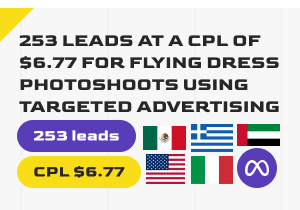
SantoriniDress.com, a company specializing in organizing photoshoots in «flying dresses».
Geography: The company operates in multiple international tourist locations, including Santorini (Greece), Italy, Dubai (UAE), and Mexico. Initially, the advertising efforts covered a wide range of countries, but later focused on specific locations like Santorini and Italy.
Task: The primary goal of the advertising campaigns was lead generation to book photoshoots. The campaigns aimed to attract potential clients, convert them into leads through various channels (lead forms, messages, website traffic), and ultimately drive sales.
Solution
The advertising strategy was built on a multi-layered approach to audience segmentation and continuous optimization based on performance data.
- Initial Audience Segmentation: Three core audience segments were defined at the start of the campaign:
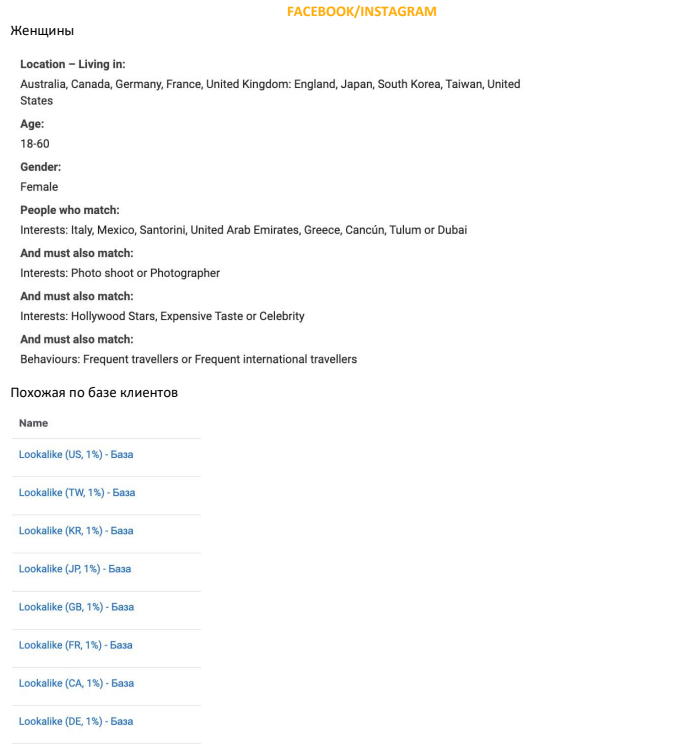
- Interest-Based Audience: This was the broadest segment, targeting women aged 18-60. Targeting was based on a combination of geographic interests (Italy, Mexico, Santorini, UAE, Greece, Dubai), activity interests (photoshoot, photographer), and behavioral/lifestyle interests (Expensive Taste, Celebrity, Hollywood Stars, fashion, regular international travelers). The geographical targeting for this audience included developed countries like Australia, Canada, Germany, France, the UK, Japan, South Korea, Taiwan, and the USA.
- Lookalike Audience: A «lookalike» audience was created based on the client’s existing customer database. This allowed targeting new users who shared characteristics with past customers, increasing the likelihood of conversion. The geography for this segment was the same as the interest-based one.
- Retargeting Audience: This segment targeted users who had previously interacted with the brand’s website or social media profiles but had not yet converted. The goal was to re-engage this warm audience with tailored messaging.
- Dynamic Audience Optimization: Throughout the campaign, the audiences were continuously refined:
- Demographic Adjustments: The age range of the target audience was adjusted multiple times based on performance data. At one point, a specific focus was placed on women aged 30+.
- Geographic Adjustments: Advertising geography was actively managed. For instance, ad delivery in Mexico was turned off in January 2023, and one of the instructions was to remove all geos from the Italy campaign except Italy itself, while focusing other campaigns solely on Santorini.
- Expansion of Lookalike Audiences: The sources for lookalike audiences were expanded beyond the initial customer list. New lookalikes were created based on users who visited the order page, watched videos, or submitted lead forms. This allowed for more precise targeting of users at different stages of the sales funnel.
- Exclusions and Segment Pausing: Underperforming audience segments were regularly paused to optimize the budget. For example, the least clickable segment was disabled, and at times, retargeting and lookalike audiences based on the customer list were also paused.
Process
The campaign management involved iterative testing of different advertising goals, formats, and creatives across multiple platforms, including Facebook, Instagram, and Twitter.
- Campaign Objectives & Formats: The primary objective evolved over time to find the most effective channel for lead generation:
- Lead Generation: Initially, campaigns were set up with the «Lead Generation» objective, using Meta’s native lead forms.
- Messages: The objective was briefly switched to «Messages» to generate direct inquiries.
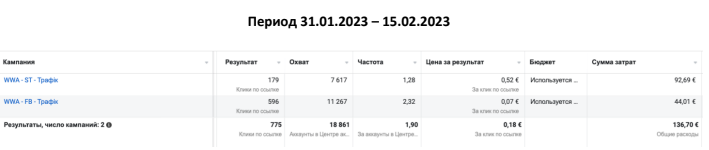
- Traffic: Due to changes in Meta’s policy that made tracking messages difficult, the main objective was shifted to «Traffic» to drive users to the website. This became the dominant campaign type observed in later reports.
- Creative Strategy & A/B Testing:
- Ad Copy: Several versions of ad copy were developed.
-
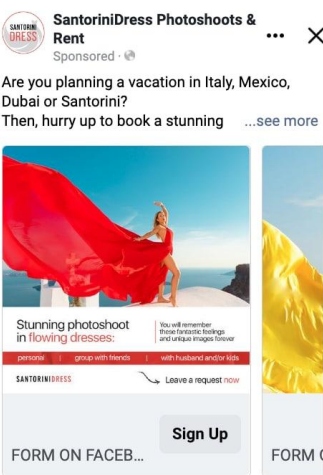
- For Cold Audiences: The texts highlighted the uniqueness of the «flying dress» photoshoot, the company’s 7-year experience, and the comprehensive service offered (photographers, 60+ dresses, videography, stylist services). The call to action was to «Leave a request now to find out all the details».
-
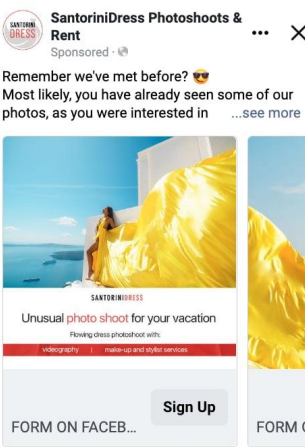
- For Retargeting: The copy was more direct, reminding users of their previous interest: «Remember we’ve met before? … If the trip is still ahead or you have time to take pictures, click on the booking button».
-
- Testing Unique Selling Propositions (USPs): The plan included testing new USPs, such as offers for early booking with an additional discount and seasonal promotions like «Book a New Year’s photo shoot».
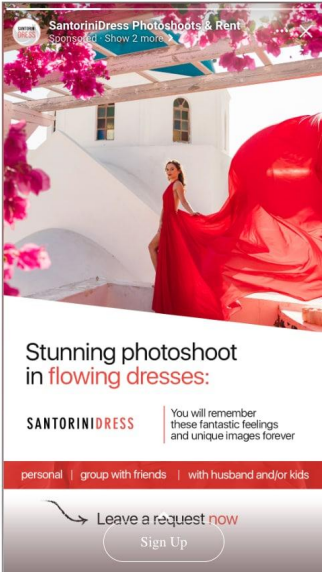
- Visuals: The reports indicate a continuous process of updating and testing creatives. This included replacing static images with videos and refreshing banners regularly to avoid ad fatigue, especially when the ad frequency exceeded 3. The initial setup included distinct ad creatives for Facebook Feed, Instagram Feed, and Stories.
- Platform Management:
- Facebook & Instagram: These were the core platforms, with campaigns often split by placement (e.g., «WWA — FB — Трафік,» «WWA — IG — Трафік,» «WWA — ST — Трафік» for Stories). Later, Instagram feed and stories campaigns were merged to better distribute the budget.
- Twitter: A traffic campaign was also run on Twitter. However, it was later paused pending the collection of a larger website audience (over 1,000 visitors) to set up more effective retargeting and lookalike audiences.
Results
Total Campaign Performance (Oct 2022 — Feb 2023):
- Total Ad Spend (Meta + Twitter): $1,713.03 USD
- Total Leads (Meta + Twitter): 253
- Average Cost Per Lead (CPL): $6.77 USD

Key Observations & Conclusion:
- Cost Fluctuation: The Cost Per Lead (CPL) showed significant fluctuation, ranging from $5.78 in October 2022 to a high of $12.01 in December 2022, before decreasing again to $6.36 in February 2023. This fluctuation was influenced by factors like budget reductions, seasonality (December), and ongoing audience testing.
- Performance Comparison (Before/After): A notable improvement in cost efficiency was achieved at the end of the observed period. The average CPL in the final month (€5.89) was nearly half of the peak CPL in December (€11.12). This demonstrates the effectiveness of the continuous optimization process, including refining audiences by age and placements and testing new creatives.
- Budget Forecast vs. Reality: An initial budget forecast estimated a CPL of $13.63 based on a projected monthly ad spend of $2,800. The actual average CPL achieved across the campaign ($6.77) was significantly lower, indicating that the advertising efforts were more efficient than initially projected, despite operating on a smaller budget than forecasted.
In conclusion, the targeted advertising campaign for SantoriniDress.com successfully generated a steady stream of leads at a cost-effective rate. The strategy of dynamic audience segmentation, continuous A/B testing of creatives and objectives, and data-driven optimization proved effective in navigating market changes and improving campaign ROI over time.
-
